
Unlocking Nature’s Symphony: Advancing Ecosystem Restoration Through Bioacoustics Monitoring
Exploring the science of sound to enhance biodiversity monitoring in South Africa
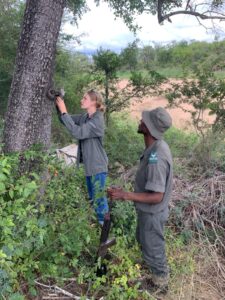
Two members of NatCarbon Africa’s Ecology Team, Rae Attridge and Corné Grobler, recently attended the Applied Bioacoustics for Conservation course held at the Skukuza Science Leadership Initiative Campus in Kruger National Park. The two-week course, running from 23 March to 5 April 2025, was an immersive experience that brought together conservationists, researchers, and technologists to explore the power of sound in ecological monitoring.
Listening Closely to Nature’s Clues
Hosted by the African Bioacoustics Community in partnership with the Organization of Tropical Studies, the course offered a unique blend of theoretical knowledge and hands-on experience in the rapidly evolving field of bioacoustics. From lectures on sound physics to field deployments deep in Kruger’s savannas, participants explored how listening can strengthen conservation and restoration science.
A strong foundation in acoustic theory was paired with practical exercises in recording and analysing soundscapes. Key concepts like frequency, amplitude, Nyquist Frequency, and Fast Fourier Transform were unpacked to help participants understand the intricacies of capturing and interpreting natural sounds. One highlight was working with Wildlife Acoustics passive recording devices, which were deployed to record a range of soundscapes, from dawn choruses to nocturnal insect activity.
Turning Sound into Conservation Action
Rae and Corné were particularly inspired by the potential of Passive Acoustic Monitoring in tracking ecosystem restoration. This approach distinguishes between biophony (animal sounds), geophony (sounds produced by natural forces like wind or rain), and anthrophony (human-made noise), revealing subtle shifts in ecosystem dynamics.
Course participants were trained in advanced software such as Kaleidoscope, Raven Pro and BirdNet Analyzer. These tools allow for species identification through spectrogram analysis, and some even use AI to classify calls automatically—a major time-saver for field ecologists. Corné noted, “What struck me most was how accessible this technology has become. It opens possibilities for long-term monitoring even in remote and logistically challenging restoration sites.”
Applying Bioacoustics to Restoration and Beyond
The relevance of bioacoustics to NatCarbon Africa’s own projects, particularly for restoration at scale, was a major takeaway. For initiatives like the Spekboom Restoration Project, integrating acoustic monitoring will provide a richer picture of how biodiversity responds over time. Standardising recording protocols and contributing data to global acoustic databases were emphasised as key next steps for this Project.
Beyond technical knowledge, the course fostered collaboration and cross-disciplinary thinking. “It reminded us that restoration at scale is not just about data, but about storytelling, community, and connection,” Rae reflected. “Sound can be a bridge between science and people.”
The Sound of What’s Possible
For NatCarbon Africa, the course reaffirmed the value of staying at the forefront of technological innovation. Bioacoustics is more than just a new method – it is a way of deepening our understanding of nature and creating measurable, lasting impact. As we continue to refine our biodiversity monitoring strategies, we look forward to applying these insights and contributing to the growing global conversation around sound-based conservation.
Article by Rae Attridge and Corné Grobler